
Does MS cause neuropathy?
If you have numb toes or tingling feet and MS is on your mind, the short answer is this: MS does not usually cause peripheral neuropathy, but it can produce numbness and tingling that feels very much like it. The pattern usually tells them apart. Neuropathy starts in both feet and creeps upward over months; MS tends to arrive over a few days, in a patch or on one side.
Numbness in MS comes from patches of inflammation in the spinal cord or brain. The nerves in your feet are healthy; the signal from them is being interrupted higher up. Peripheral neuropathy is the reverse. The long nerves running to the feet and hands are themselves damaged, most often by diabetes, vitamin B12 deficiency, alcohol, an autoimmune process, or a cause that is never found. So "MS neuropathy" is not really one thing. It is either MS producing sensory symptoms through the central nervous system, or a separate peripheral neuropathy in someone who also happens to have MS.
If your main worry is MS itself, early signs of multiple sclerosis covers what a first attack usually looks like. If your main worry is your feet, neuropathy in the feet covers symptoms, causes, and when to be seen. This page is about telling the two apart.
Is MS central or peripheral?
MS is a disease of the central nervous system: the brain, the spinal cord, and the optic nerves. The immune system attacks myelin, the insulation around nerve fibers, and over time the fibers themselves. So MS does cause nerve damage, but the damage is inside the skull and spine.
The peripheral nervous system is everything else, meaning the nerves that leave the spinal cord and run to the skin, muscles, and organs. Peripheral neuropathy is damage to those. The two systems are insulated by different cells and are affected by different diseases, which is why MS almost never damages peripheral nerves directly and why the tests for each are different.
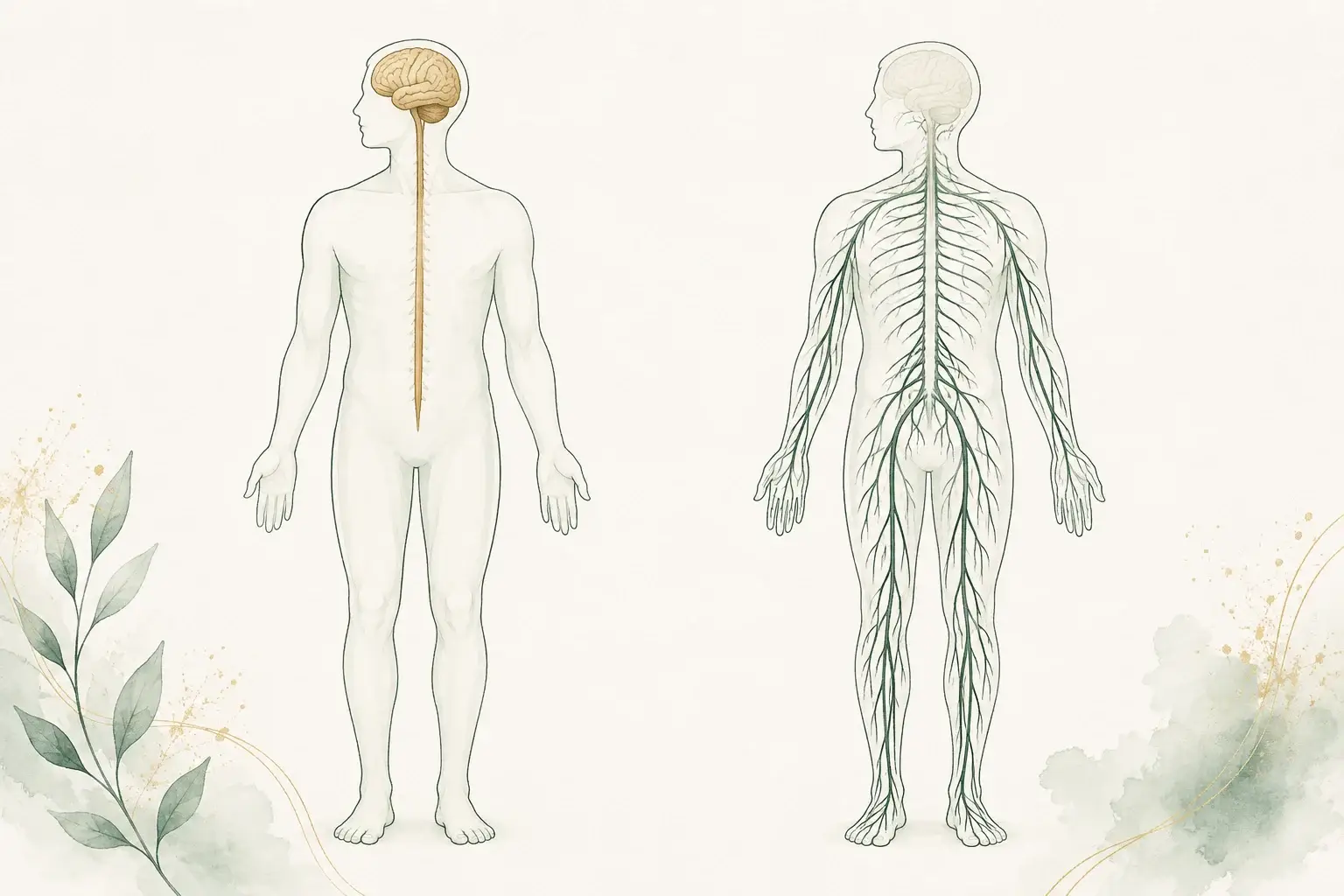
The location of nerve damage differs
- Central nervous system: MS affects the brain, spinal cord, and optic nerves.
- Peripheral nerves: Neuropathy affects nerves beyond the brain and spinal cord.
- Choose the right tests: The examination guides MRI, nerve studies, or skin biopsy.
Key differences at a glance
| Feature | Peripheral neuropathy | Multiple sclerosis |
|---|---|---|
| Part of nervous system | Peripheral nerves, outside the brain and spinal cord | Brain, spinal cord, and optic nerves |
| Where symptoms start | Toes, then feet, then fingers, on both sides | Anywhere, often one limb, one side, the trunk, or the face |
| How fast | Creeps in over months to years | Comes on over days, often improves over weeks, may come back |
| Vision | Not affected | Blurred or painful vision in one eye, double vision |
| Fatigue and thinking | Not typical | Deep fatigue and slowed thinking are common |
| Bladder | Only in autonomic neuropathy | Urgency or difficulty emptying is common |
| Reflexes on examination | Often reduced or absent in large-fiber neuropathy, typically normal in pure small fiber neuropathy | Usually brisk when the spinal cord is involved, with stiffness in the legs |
| Main test | Nerve conduction studies, skin biopsy, blood tests | MRI of the brain and spinal cord |
| Who it affects | Any age, more often older adults | Most often diagnosed between ages 20 and 40 |
How the symptoms compare
Numbness and tingling. Peripheral neuropathy almost always begins in the toes and works its way up, affecting both feet about equally, in the area a sock would cover. It often burns or prickles, is worse at night, and progresses over months to years. The hands join in later. MS numbness follows no such map. It can appear on one side of the trunk, in one leg, across the face, or as a tight band around the chest or waist that people call the MS hug. It usually develops over a few days and may then fade over weeks.
One side or both sides. People often ask whether MS tingling is usually on one side. Often it is, because a single patch of inflammation affects one pathway. But a lesion in the spinal cord can interrupt signals to both legs at once, so symptoms on both sides do not rule MS out. The more useful clue is the shape: a symmetric stocking pattern that started in the toes points to neuropathy, while a patch or a level across the body points to the spinal cord.
Weakness and balance. In neuropathy, weakness arrives late and at the far ends of the limbs, classically as difficulty lifting the front of the foot. Balance suffers because the feet cannot feel the floor, which is why it is worse in the dark. In MS, weakness can involve one whole limb, often with stiffness or spasticity, and unsteadiness comes from the cerebellum or brainstem, sometimes with tremor or clumsy hands.
Vision, fatigue, thinking, and bladder. These belong to the central nervous system, so they are the clearest separators. Pain behind one eye with blurred vision, double vision, a heavy fatigue that rest does not fix, slowed thinking, and new bladder urgency are all features of MS. Peripheral neuropathy does not cause them, with one exception: autonomic neuropathy can affect bladder, gut, and blood pressure control.
Time course. Neuropathy usually worsens slowly and steadily. MS, in its commonest form, comes in episodes with partial or full recovery between them.

What changes when myelin is damaged
Myelin
An insulating covering around many nerve fibers. Short gaps between its segments are normal.
Nerve fiber (axon)
The fiber inside carries electrical messages. The covering and the fiber are different structures.
Damaged myelin
Loss of this covering can slow or block signals. In MS, the nerve fiber itself can also be injured.
Numb feet or toes: MS or neuropathy?
Numb or tingling feet are the symptom that most often brings this question up. Where the numbness started, how it spread and what came with it usually point one way before any test is done.
| Clue | Points to peripheral neuropathy | Points to MS in the spinal cord |
|---|---|---|
| Where it started | Both big toes or both soles at once | One foot or leg, or both legs below a level on the trunk |
| How it spread | Up to the ankles over months, the fingertips later | Over hours to days, sometimes up to the waist |
| How it feels | Burning, pins and needles, worse at night | Numb, tight or buzzing, sometimes a band around the trunk |
| What comes with it | Diabetes, low vitamin B12, heavy alcohol use | Bladder urgency, an electric jolt down the back when bending the neck, symptoms worse in heat |
| First test | Nerve conduction studies, blood tests, sometimes a skin biopsy | MRI of the spine and brain |
For the neuropathy side, from causes to treatment, see neuropathy in the feet.
Pinched nerve or MS?
A pinched nerve in the neck or lower back is a third, and much more common, cause of numbness that gets confused with MS. It follows the path of one nerve root: down one arm, ending in numbness in particular fingers, or down one leg into the foot, which is sciatica. It usually comes with neck or back pain and is often worse in certain positions. MS numbness ignores those maps and is not tied to a sore neck or back. The examination separates them well, and an MRI of the neck or lower spine confirms a pinched nerve, while an MRI of the brain and spinal cord looks for MS. Our pinched nerves page covers the details.
How a neurologist tells them apart
The examination comes first and does a lot of the work. Reflexes are often reduced or absent in large-fiber neuropathy and typically normal in pure small fiber neuropathy, while MS with spinal cord involvement usually makes them brisk. Sensation is tested to map the pattern. Eye movements, coordination, and gait point toward or away from the central nervous system. By the end of the examination the direction of testing is usually clear.
When the direction is MS, the test is MRI of the brain and spinal cord, which shows the characteristic lesions. Spinal fluid is added when the picture needs support, through a lumbar puncture we arrange with interventional radiology. Our MS evaluation page describes the full process, and understanding your MS brain MRI explains what the scan shows.
When the direction is neuropathy, the work is finding the cause. Blood tests look for diabetes, B12 deficiency, thyroid disease, and autoimmune markers. Nerve conduction studies and EMG, arranged through an outside electrodiagnostic lab, measure the large nerve fibers. When the EMG is normal but burning pain continues, a skin punch biopsy, done in our Beverly Hills office, counts the small fibers. The neuropathy workup is laid out step by step on neuropathy in the feet.
When the pattern fits neither cleanly, both directions are ordered from the same visit rather than one after the other.
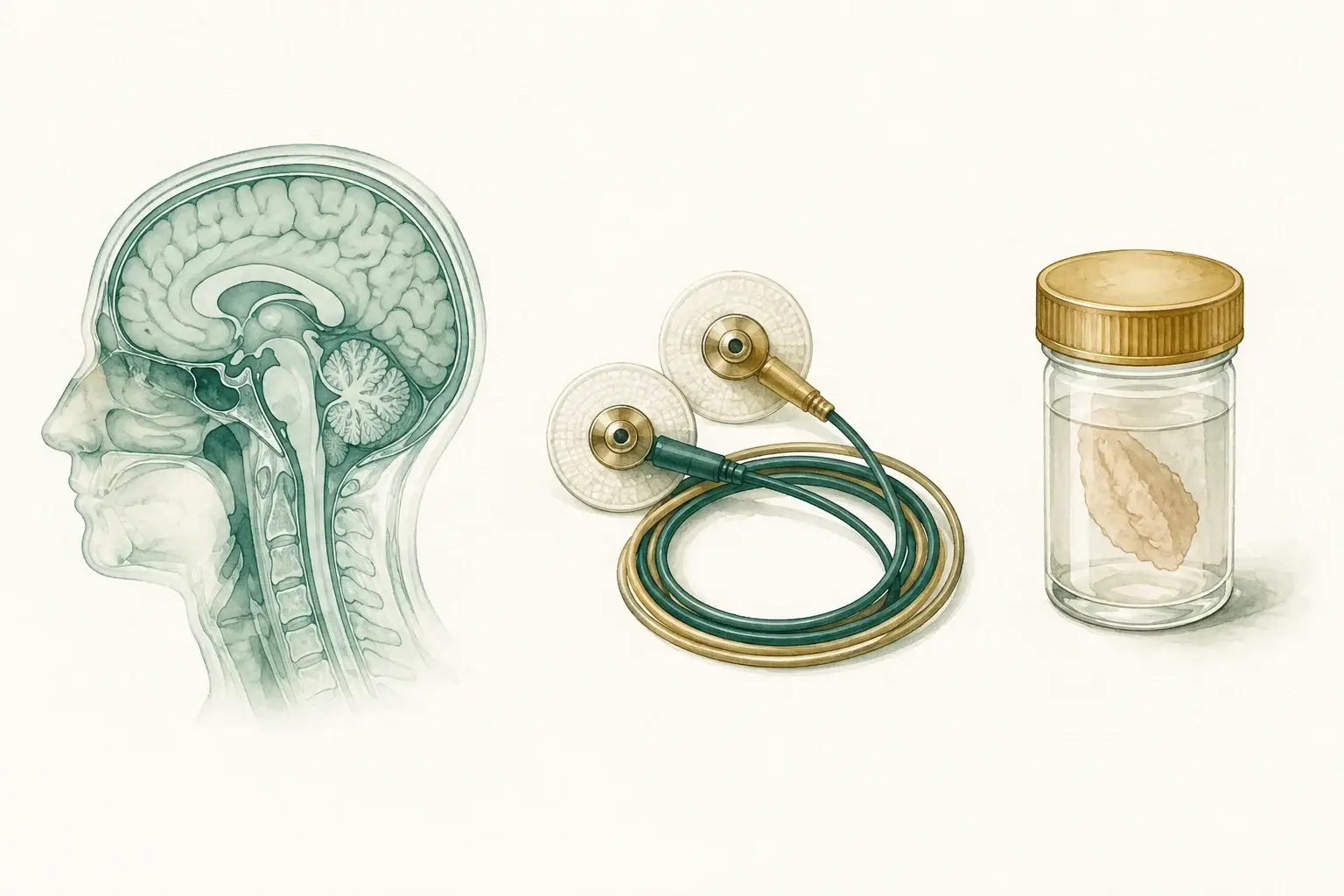
Different tests examine different pathways
- MRI: Imaging assesses the brain and spinal cord when central disease is suspected.
- Nerve studies: Electrical testing evaluates peripheral nerve function.
- Skin biopsy: Small-fiber evaluation may be useful when standard nerve studies are normal.
When symptoms overlap
Some situations blur the line, and they are the reason the examination matters more than any single symptom.
Both at once. A person with MS can develop a separate peripheral neuropathy from diabetes, B12 deficiency, alcohol, or chemotherapy, since none of those causes checks for MS first. Peripheral nerve involvement directly from MS is reported but rare.
Diseases that affect both systems. Sarcoidosis, Sjögren's syndrome, lupus, and severe B12 deficiency can injure the central and peripheral nervous systems together. Our autoimmune conditions page covers these.
Central causes that mimic neuropathy. Compression of the spinal cord in the neck, called cervical myelopathy, produces numb, clumsy hands and stiff legs that can be mistaken for neuropathy. Spinal cord lesions from MS or other demyelinating diseases can do the same. If you were told you have MS and are not sure, MS or something else walks through the mimics.
Small fiber neuropathy and MS
Small fiber neuropathy causes burning feet with a normal EMG, and it can coexist with MS or be mistaken for it. A skin biopsy settles whether the small fibers are reduced; see how reliable a skin biopsy is for what a normal count can and cannot rule out.
What makes a neurologist think central rather than peripheral
This is not a checklist to score yourself against; it is what the neurologist is weighing while you describe your symptoms and during the examination. The features that pull toward the central nervous system are numbness in a patch or across a level of the body rather than a stocking, involvement of the face or trunk, an episode that built over days and then improved, pain behind an eye with blurred vision, brisk reflexes and a stiff walk on examination, new bladder urgency, and onset in young adulthood. None of these alone diagnoses MS. Together they are what makes a neurologist order a brain and spine MRI first rather than nerve studies.
The features that pull the other way are just as useful: numbness that began in both big toes and crept upward, absent ankle reflexes, diabetes or heavy alcohol use, and no vision, bladder, or cognitive change. You do not need to work out which side you fall on before you come in. Describing where it started and how it spread is what matters.
When numbness is an emergency
Sudden numbness or weakness on one side of the body, a drooping face, trouble speaking, or sudden loss of vision can be a stroke. Call 911 rather than waiting for a neurology appointment.
When to see a neurologist
Persistent numbness, tingling, or weakness deserves an evaluation whichever direction it points, because peripheral neuropathy has treatable causes that are easier to reverse early and MS responds best to treatment started soon after diagnosis. A neurological evaluation is where both start. Tingling with MS on your mind is hard to ignore. In a 60-minute first visit, Dr. Achillefs Ntranos works out which direction it points, so you know which tests come next. Follow-ups are usually every one to three months and last 30 minutes, or 30 to 45 for MS care. Request a visit in Beverly Hills or Los Angeles, or by video anywhere in California. No referral is needed; the office confirms within 1 business day.
Frequently asked questions
References
- National Institute of Neurological Disorders and Stroke. Peripheral Neuropathy.
- National Institute of Neurological Disorders and Stroke. Multiple Sclerosis.
- National Multiple Sclerosis Society. Numbness or Tingling.
- Mayo Clinic. Peripheral neuropathy: symptoms and causes.
- Cleveland Clinic. Hyporeflexia.
- National Multiple Sclerosis Society. What is MS?
- Combined central and peripheral demyelination: clinical features, diagnostic findings and treatment. Journal of the Neurological Sciences, 2016.
- MedlinePlus, U.S. National Library of Medicine. Multiple sclerosis.