
What should you eat if you have MS?
If you have been diagnosed with multiple sclerosis, "what should I be eating?" is often one of the first questions you ask. No diet cures MS or replaces your medication. Food still matters, though, and it is something you decide three times a day.
The short answer: eat the way the best-studied heart-healthy and brain-healthy diets already recommend. Mostly plants, fish more often than red meat, olive oil rather than butter, whole grains rather than white flour, and as little ultra-processed food as your life allows. That pattern has the strongest evidence in MS, and every popular "MS diet" is a stricter version of it. The rest of this guide covers what the evidence shows, how the named diets compare, which nutrients are worth a blood test, and what is worth limiting.
Why diet matters in MS
MS is a disease of neuroinflammation: the immune system attacks myelin, the insulating coating around nerve fibers. Disease-modifying therapy is the main tool for controlling that attack. Diet has a supporting role, and research is steadily clarifying what that role is.
- Inflammation. Diets heavy in processed food, added sugar, and saturated fat are associated with higher inflammatory markers in the blood. Diets built on vegetables, fruit, legumes, fish, and olive oil are associated with lower ones.
- The gut microbiome. The bacteria in your gut train and regulate your immune system, and people with MS tend to have a different mix of them than people without MS. Fiber from vegetables, fruit, legumes, whole grains, nuts, and seeds feeds the bacteria that make anti-inflammatory compounds, and fermented foods add helpful bacteria directly. Our guide to the gut-brain axis covers this in depth.
- Vascular health. High blood pressure, high cholesterol, diabetes, and obesity are each linked to faster accumulation of disability in MS. Eating well protects the blood vessels that supply the brain, which matters as much in MS as it does for the heart.
- Symptoms. Diet quality tracks with fatigue, mood, and thinking in people with MS. That is the benefit most people actually notice.
Can MS be cured or reversed with diet?
No. This is the one point worth being blunt about, because it is the claim you will meet most often online.
Diet complements disease-modifying therapy. It does not replace it.
No diet, supplement, or nutrition protocol has been shown to stop relapses, prevent new lesions on MRI, or reverse disability. Those are what disease-modifying therapies are proven to do. Diet supports your brain, your energy, and your long-term health alongside that treatment. If you are thinking about changing or stopping a medication because of a diet you have read about, talk to your neurologist first.
What diet can do is still meaningful: less fatigue, better weight and vascular health, and a healthier gut. Stories of people who "reversed MS with food" usually reflect the natural ups and downs of relapsing MS, a medication working in the background, or both.
The anti-inflammatory eating pattern
Before any named diet, it helps to see the pattern they all share. The strongest evidence in MS points to an anti-inflammatory way of eating: whole, minimally processed foods, plenty of plants, healthy fats, and less of the foods that drive inflammation.
Reach for more:
- Fatty fish (salmon, mackerel, sardines)
- Vegetables, especially leafy greens and colorful ones
- Berries and whole fruit
- Whole grains (oats, quinoa, brown rice)
- Nuts and seeds (walnuts, flaxseed, chia)
- Olive oil and avocado
- Legumes (beans, lentils, chickpeas)
- Fermented foods (yogurt, kefir, kimchi)
What to cut back on, with the reason and an easy swap for each, is in the table of foods to avoid with MS.
Think of this as a long-term pattern rather than a diet with an end date. Most meals from this list, with room for the occasional pizza or birthday cake, is the realistic goal. The same pattern applies across other demyelinating diseases, because the biology of inflammation and vascular health is shared.
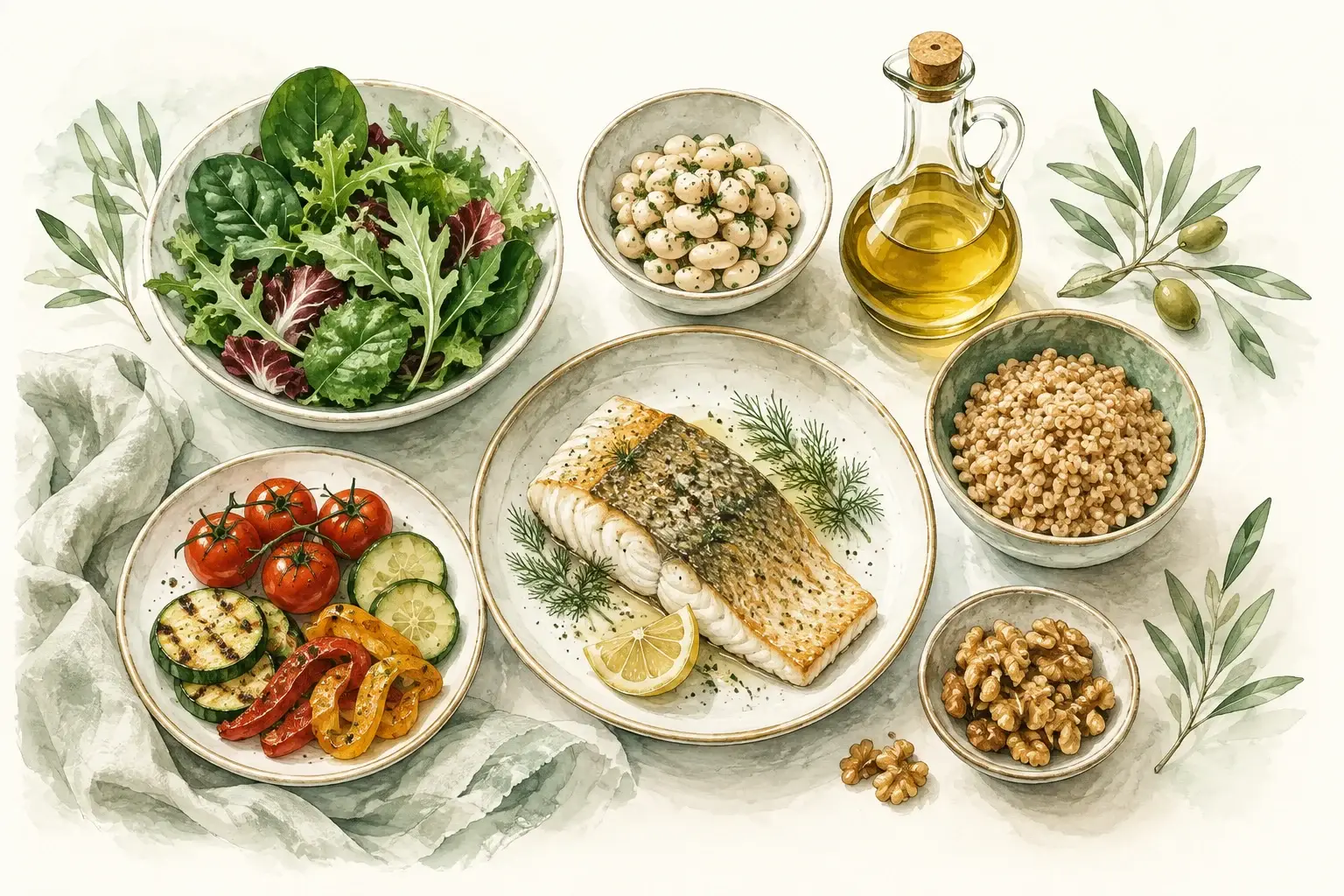
Build meals around a familiar pattern
- Plant foods: Include vegetables, fruit, legumes, and whole grains.
- Choose fats thoughtfully: Fish, nuts, and olive oil fit the eating pattern described here.
- Keep treatment in place: Diet supports care and does not replace disease-modifying therapy.
Popular MS diets: what the evidence says
Several named diets are widely discussed in the MS community. Each has a following and a research base, and none has been shown to beat an overall healthy diet in a head-to-head trial.
The Mediterranean diet
Vegetables, fruit, legumes, whole grains, nuts, olive oil, and fish, with moderate poultry and dairy and little red meat. It is the best-studied pattern in MS. Higher adherence is associated with less disability, less fatigue, better cognition, and better quality of life, and small trials have reported lower inflammatory markers. It eliminates no food group, which makes it the easiest of the three to keep up for years.
The Wahls protocol
Developed by Dr. Terry Wahls, a physician who has MS herself, it is a modified paleo diet: a large daily volume of vegetables split between leafy greens, sulfur-rich vegetables, and deeply colored produce, plus quality protein, organ meats, and seaweed, while removing grains, dairy, eggs, and legumes. Small clinical trials, mostly from the Wahls research group, have shown improvements in fatigue, walking, and quality of life. It is nutrient-dense but demanding to follow, and a nutrient analysis of people on the diet found that some fell short on calcium and vitamin B12 unless they supplemented. People searching for a "paleo diet for MS" usually land here: standard paleo shares the eliminations without the deliberate vegetable emphasis.
The Swank diet
Dr. Roy Swank's diet dates from the 1940s and sets a strict cap on saturated fat while emphasizing unsaturated fats, especially from fish. Swank followed his patients for decades and reported less progression among those who stuck to the diet, but the study had no randomized control group and relied on self-reported adherence. Its core idea, less saturated fat, fits current advice. Its strictness does not, and a very low-fat diet needs careful planning to avoid shortfalls.
Other diets you may have heard of
- Overcoming MS (OMS) is a plant-based, very low saturated fat program descended from Swank, combined with exercise, sunlight, and meditation. Its evidence comes from observational studies of program participants.
- Best Bet removes dairy, gluten, legumes, and eggs on a "leaky gut" theory that has not been confirmed in trials.
- Gluten-free eating helps people with MS who also have celiac disease. There is no evidence it helps others.
- Ketogenic and fasting approaches are under active study for fatigue and inflammation. They are hard to sustain and should not be started without medical supervision.
MS diets at a glance
| Mediterranean | Wahls protocol | Swank diet | |
|---|---|---|---|
| Core idea | Anti-inflammatory whole foods | Nutrient density on a paleo frame | Very low saturated fat |
| Evidence | Strongest, multiple studies | Small trials, mostly one research group | Old, uncontrolled follow-up |
| Food groups removed | None | Grains, dairy, eggs, legumes | None, but fat is tightly capped |
| Easy to keep up? | Yes | Takes planning and money | Takes planning |
If you are choosing where to start, the Mediterranean pattern has the best evidence and the fewest trade-offs. Elements of the others, above all the Wahls emphasis on vegetables, fit inside it without the eliminations.
Key nutrients for MS
Vitamin D
Vitamin D is the nutrient with the deepest MS research base. Low levels are an established risk factor for developing MS, and people with MS who have low levels tend to have more MRI activity and, in some studies, more relapses. Whether supplementing changes that course is still being tested, but correcting a deficiency is standard care. Our guide to vitamin D and MS explains what the trials have found so far.
The one thing not to do is guess. Vitamin D is fat-soluble, and too much causes calcium problems and can harm the kidneys. Your neurologist will check your level with a blood test, recommend a dose based on the result, and recheck it. If you already take an over-the-counter product, say so at your visit so the dose can be adjusted.
Omega-3 fatty acids
The long-chain omega-3s in fish, EPA and DHA, dampen inflammatory signaling. In MS, omega-3s have lowered inflammatory markers in several studies and may help fatigue and quality of life. Evidence that they reduce relapses is mixed. Fatty fish most weeks is the food-first route. If you do not eat fish and are considering a fish oil supplement, choose one that is third-party tested and ask your neurologist whether it fits your plan.
Vitamin B12
Low B12 causes numbness, fatigue, and thinking problems that can mimic or worsen MS symptoms. It is easy to check and easy to correct, and it is worth testing if you eat little or no animal food or take a stomach-acid reducer.
Foods to avoid with MS, and habits to limit
Nothing is strictly forbidden, but these foods work against the pattern above, and each has an easy swap.
| Limit | Why | Swap for |
|---|---|---|
| Fast food, packaged snacks and ready meals | High in salt, refined starch and unhealthy fats; low in fiber | Batch-cooked meals from your freezer, fruit, nuts |
| Added sugar (soda, candy, baked goods) | A short lift followed by a longer slump; linked to higher inflammatory markers | Fruit, sparkling water, plain yogurt with berries |
| Refined carbohydrates (white bread, pastries) | Little fiber and unsteady blood sugar, which feeds fatigue | Whole-grain bread, oats, brown rice |
| Red and processed meat | Saturated fat, plus salt in processed meat | Fish, legumes, poultry |
| Fried food and other sources of saturated and trans fat | Linked to higher inflammatory markers and to vascular disease | Olive oil; baking, roasting or grilling |
| Alcohol | Worsens fatigue, balance and sleep, and interacts with some MS medications; many people with MS find that less is noticeably better | Sparkling water with citrus, or an alcohol-free version |
| Salt-heavy foods | Excess salt may increase inflammatory immune activity in MS, though the evidence is early | Fresh rather than processed food, seasoned with herbs, spices and lemon |
The habits and questions people with MS ask about most are these.
Can food cause an MS flare-up?
No food has been shown to cause a relapse. What many people notice is that certain things temporarily make existing symptoms worse: a heavy, high-fat meal that leaves you exhausted, a hot drink or hot soup that brings on the heat sensitivity familiar to people with MS, dehydration that worsens fatigue and bladder symptoms, or alcohol that affects balance and sleep. These are pseudo-relapses: old symptoms resurfacing for a while, not new inflammation. Our guide to what to do during a relapse explains how a neurologist tells the two apart. If you suspect a food triggers a symptom, keep a simple log for a few weeks and bring it to your visit.
Habits that work against you
- Smoking is the lifestyle factor most clearly linked to faster MS progression. Quitting is the single most effective change on this list.
- Skipping meals and dehydration both feed fatigue and brain fog.
Supplements: what is worth taking?
The supplement aisle is where MS advice becomes least reliable. A practical way to sort it:
Guided by a blood test: vitamin D and vitamin B12. Your neurologist will check your level and recommend a dose if you need one.
Reasonable to discuss: omega-3 fish oil if you eat little fish; probiotics, though the right strain and amount for MS are not established; magnesium if your diet is low in it.
Vitamins to avoid with MS, or approach with caution
- High-dose biotin. Early enthusiasm from small studies was not confirmed in a large randomized trial, and some reports have raised concern about increased disease activity. It also interferes with common lab tests, including thyroid tests.
- Megadoses of fat-soluble vitamins (A, D, E, K). More is not better, and excess is stored rather than excreted.
- Immune-boosting products. MS is a disease of an overactive immune system, so supplements marketed to "boost immunity" run against the goal of treatment. Evidence of harm is thin, but there is no evidence of benefit.
- Anything sold as an MS cure. Nothing sold as a supplement has that evidence.
Tell your neurologist about every supplement you take. Some interact with MS medications and some, like biotin, distort lab results.

Make supplement decisions with evidence
- Check relevant levels: Vitamin D and B12 can be assessed with blood tests.
- Individualize the plan: Your clinician can recommend supplements when a need is identified.
- Avoid replacement claims: Supplements do not take the place of disease-modifying therapy.
A 7-day MS meal plan
Here is one week in the Mediterranean pattern this guide recommends. Each day also has a low-energy version built from frozen, batch-cooked or no-cook food, because a plan has to survive a bad week. Swap meals freely: the pattern matters more than the recipes.
| Day | Breakfast | Lunch | Dinner | Snack | Low-energy version |
|---|---|---|---|---|---|
| Monday | Oatmeal with berries and walnuts | Lentil soup, whole-grain bread, green salad | Baked salmon, roasted vegetables, quinoa | Apple and almonds | Microwave oats with frozen berries; canned lentil soup; frozen salmon and frozen vegetables baked on one tray |
| Tuesday | Greek yogurt with fruit and ground flaxseed | Leftover salmon and quinoa over spinach | Chickpea and vegetable stew with brown rice | Carrots and hummus | Bagged spinach with canned chickpeas and olive oil; stew from the freezer |
| Wednesday | Whole-grain toast with avocado and an egg | Leftover stew | Whole-wheat pasta with tomato sauce, white beans and spinach | Pear and walnuts | Jarred tomato sauce, canned beans and frozen spinach stirred into pasta |
| Thursday | Oatmeal with banana and chia seeds | Tuna or white bean salad with greens and whole-grain crackers | Chicken or tofu stir-fry with vegetables and brown rice | Berries and plain yogurt | Frozen stir-fry vegetables with microwave brown rice |
| Friday | Smoothie of spinach, frozen berries, yogurt and flaxseed | Leftover stir-fry | Sardines or mackerel, roasted potatoes, green salad | Olives and whole-grain crackers | Canned sardines on whole-grain toast with a bagged salad |
| Saturday | Vegetable omelet with whole-grain toast | Farro bowl with roasted vegetables, chickpeas, feta and olive oil | Fish tacos with cabbage slaw | Orange and pistachios | Canned salmon or beans in tortillas with pre-shredded slaw mix |
| Sunday | Whole-grain pancakes with berries and yogurt | Minestrone with beans and whole-grain bread | Roast chicken, root vegetables and greens, with extra grains and vegetables cooked for the week | Hummus and vegetables | Rotisserie chicken, microwave grains and a bagged salad |
Portions depend on your size, activity and appetite. A dietitian can adapt the plan to your preferences, your budget and any other medical diet you follow.
Making it work on low-energy weeks
Knowing what to eat is one thing. Doing it with fatigue, brain fog, and a full life is another. A plan that survives a bad week looks like this:
- A plate template instead of recipes. Half vegetables, a quarter protein (fish, legumes, poultry, eggs), a quarter whole grain or starchy vegetable, olive oil on top. Fruit and nuts for snacks. That is a Mediterranean meal without a cookbook.
- Batch cook on good days. Grains, roasted vegetables, and a protein cooked in bulk make a week of mix-and-match meals, and freeze well for days when cooking is impossible.
- Stock the freezer. Frozen berries, spinach, mixed vegetables, and fish fillets are as nutritious as fresh and need no prep. Grocery delivery and pre-cut vegetables earn their cost on low-energy weeks.
- Add before you subtract. An extra serving of vegetables or a handful of walnuts crowds out less helpful choices without a fight.
- Move as well as eat. Diet and exercise reinforce each other in MS: regular activity improves fatigue, mood, and vascular health. Our guide to lifestyle changes in MS covers exercise, sleep, and heat management.
- Ask for a dietitian referral if you want a plan built around your preferences, budget, and energy. It is a reasonable request at any MS visit.
Best foods for MS fatigue
Fatigue is the symptom diet touches most directly. The foods that help are the ones that keep blood sugar steady: protein and fiber at every meal, whole grains rather than refined ones, and regular meals rather than a long gap followed by a large one. Adequate fluid matters more than most people expect. Sugary snacks and heavy, high-fat meals give a short lift followed by a longer slump. If fatigue is severe or new, it deserves a medical look rather than a menu change, since low vitamin D, low B12, thyroid problems, poor sleep, and depression all cause it and all are treatable.
At our multiple sclerosis clinic in Los Angeles, nutrition is part of every MS evaluation, alongside medication, sleep, and exercise. If you are planning a pregnancy, our guide to MS and pregnancy covers how nutrition and medication timing are coordinated. Online diet advice for MS is loud and contradictory. In a 60-minute first visit, Dr. Achillefs Ntranos sorts out with you which changes are worth your energy. Follow-ups are usually every one to three months and last 30 to 45 minutes. Request a visit in Beverly Hills or Los Angeles, or by video anywhere in California. No referral is needed, and the office confirms within 1 business day.
Frequently asked questions
References
- U.S. Department of Veterans Affairs, Multiple Sclerosis Centers of Excellence. Diet and Multiple Sclerosis.
- Weill Cornell Medicine Multiple Sclerosis Center. What is the best diet for patients with MS?
- Titcomb TJ, et al. Change in Micronutrient Intake among People with Relapsing-Remitting Multiple Sclerosis Adapting the Swank and Wahls Diets: An Analysis of Weighed Food Records. Nutrients, 2021.
- Wahls TL, et al. Impact of the Swank and Wahls elimination dietary interventions on fatigue and quality of life in relapsing-remitting multiple sclerosis: the WAVES randomized parallel-arm clinical trial. Multiple Sclerosis Journal, Experimental, Translational and Clinical, 2021.
- National Institutes of Health, Office of Dietary Supplements. Vitamin D Fact Sheet for Consumers.
- Mowry EM, et al. Vitamin D status predicts new brain magnetic resonance imaging activity in multiple sclerosis. Annals of Neurology, 2012.
- Mokry LE, et al. Vitamin D and risk of multiple sclerosis: a Mendelian randomization study. PLOS Medicine, 2015.
- Cree BAC, et al. Safety and efficacy of MD1003 (high-dose biotin) in patients with progressive multiple sclerosis (SPI2): a randomised, double-blind, placebo-controlled, phase 3 trial. The Lancet Neurology, 2020.
- Branger P, et al. Relapses during high-dose biotin treatment in progressive multiple sclerosis: a case-crossover and propensity score-adjusted prospective cohort. Neurotherapeutics, 2020.
- Biogen. VUMERITY (diroximel fumarate) prescribing information. DailyMed, US National Library of Medicine.
- MS Trust. Uhthoff's phenomenon.