
What does MS look like on a brain MRI, compared with a normal brain?
You have your MRI report, and it is written in a language you were never taught. "Periventricular white matter lesions." "No enhancing lesions." "Stable disease burden." You cannot tell whether to be relieved or worried. Radiology reports are written for the neurologist who ordered them, not for the person whose brain they describe, and read cold they cause a great deal of avoidable anxiety.
Here is what MS looks like on the scan. On the T2 and FLAIR images, two standard types of MRI picture, MS appears as bright white spots against the gray of normal brain tissue. They tend to be oval rather than round, often sit against the fluid-filled ventricles in the middle of the brain, and sometimes point away from them like fingers. Some lesions light up after contrast dye, which means they are inflamed right now. On the T1 images, a few older lesions look dark. Over years, the brain may lose a little volume faster than aging alone would explain.
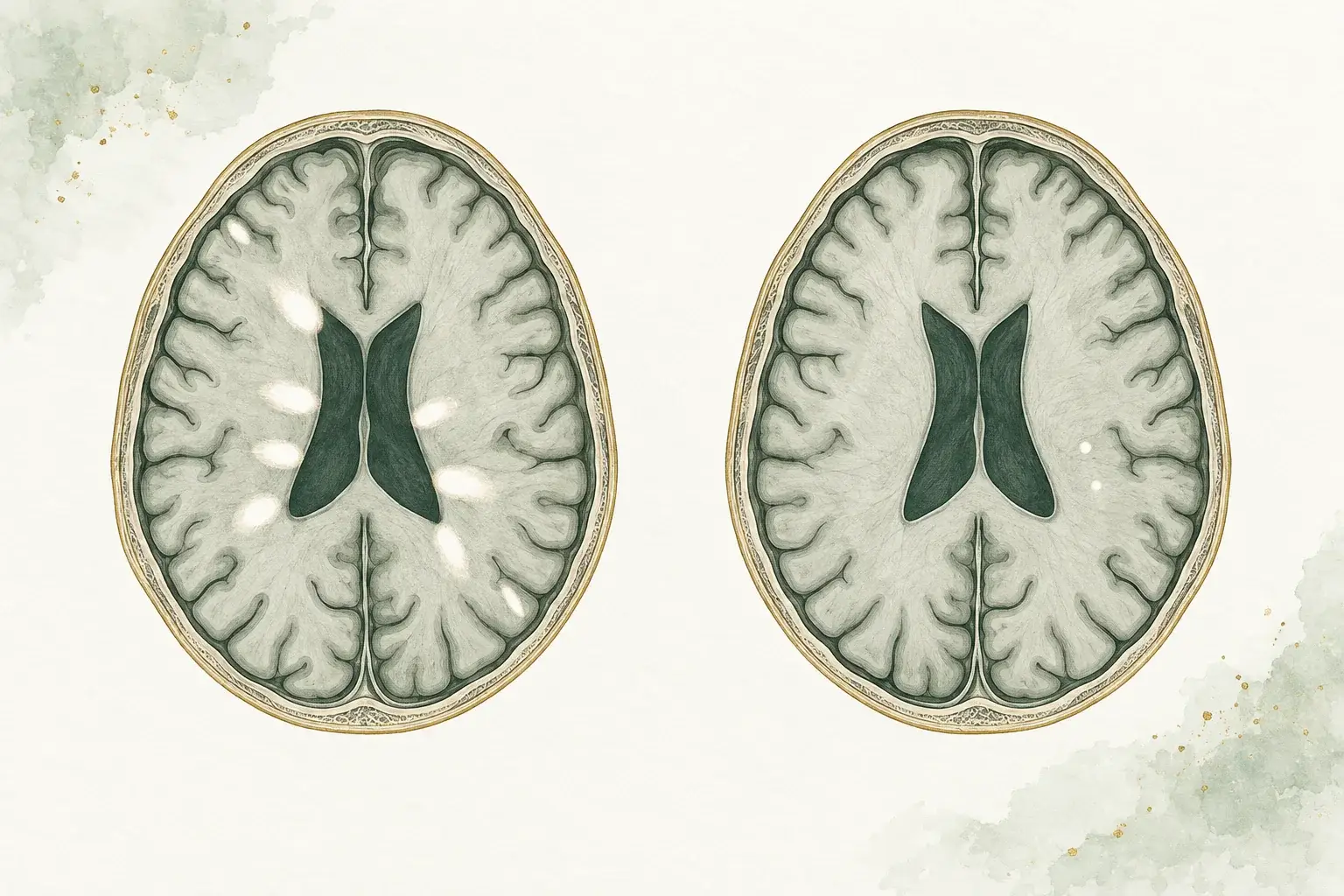
An MS brain next to a healthy brain
- MS (left): Oval spots sit against the ventricles, some pointing away from them like fingers, with others at the edge of the cortex.
- Healthy brain (right): The tissue is even; one or two tiny dots are common with age and are not MS.
- Spots are not a diagnosis: Your neurologist reads the images together with your symptoms and examination.
One thing first: many adults over forty have a few small white spots on a brain MRI that are not MS, so spots alone are not a diagnosis. The rest of this guide explains each finding and what a new one means for your treatment. It is a guide to understanding your report, not a substitute for the conversation with your neurologist, who reads the images together with your symptoms and examination.
Why MRI is essential for MS
MRI is the single most important tool for diagnosing and monitoring multiple sclerosis. MS causes changes in the brain and spinal cord that MRI can see long before they cause anything you would notice, and often before any other test would show them.
For diagnosis, MRI supplies most of the evidence the 2024 McDonald criteria require: proof that demyelination has happened in more than one part of the central nervous system, and at more than one point in time. A single scan can often show both, for example an old lesion beside a new enhancing one.
For monitoring, repeat MRIs show whether the disease is active beneath the surface. MS, especially relapsing-remitting MS, forms new lesions silently much of the time. A scan that shows new lesions in someone who feels well is not a contradiction. It is the reason the scan is done.
Types of MS lesions explained
Not every lesion on an MS brain MRI means the same thing. The report describes each type by the MRI sequence it shows up on, and each tells a different part of the story.
| Finding | Image type | What it tells your neurologist | Does it go away? |
|---|---|---|---|
| T2 or FLAIR lesion (white spot) | T2 and FLAIR images | Where myelin has been damaged. The total, old and new together, is the disease burden | Some shrink or fade as myelin partly repairs; most leave a lasting mark |
| Enhancing lesion | T1 images after contrast | Inflammation that is active now, usually within the past several weeks | The enhancement fades within weeks, but the white spot may remain |
| Persistent T1 black hole | T1 images without contrast, on scans months apart | An older lesion where nerve fibers, not only myelin, were lost | No. That loss does not reverse |
T2 and FLAIR lesions: the white spots
T2-weighted and FLAIR (fluid-attenuated inversion recovery) images are the workhorses of MS imaging. On them, white matter lesions appear as bright spots. Each one is a place where the myelin coating around nerve fibers has been damaged by neuroinflammation.
The total number and size of T2 lesions is what reports call disease burden or lesion load. Put simply, T2 lesions are a record of all the inflammation MS has caused so far. They include old, partly healed lesions and new ones, and the scan alone cannot always tell which is which. A T2 lesion does not automatically mean permanent damage. Some have remyelinated and recovered. Others reflect deeper injury.
Enhancing lesions: inflammation that is active now
Gadolinium contrast, given through an IV during the scan, leaks into tissue only where the blood-brain barrier is open. In MS that happens where the immune system is actively attacking myelin. On the post-contrast T1 images, those lesions light up as a bright spot or ring. Reports call them enhancing, active, or contrast-enhancing lesions. Contrast is avoided during pregnancy, and a scan without it is done only when there is a clinical reason, as our guide to MS and pregnancy explains.
Enhancement fades within weeks as the inflammation settles, so an enhancing lesion tells your neurologist that MS has been active very recently. "No enhancing lesions" on a monitoring scan means no active inflammation was caught, and it is the phrase everyone hopes to read.
T1 black holes: older lesions with more damage
On T1-weighted images without contrast, some lesions appear dark. Radiologists call them T1 hypointense lesions or black holes. During an active relapse a lesion can look dark temporarily and then recover. A lesion that stays dark on scans months later is a place where a significant number of nerve fibers, not only their myelin coating, were lost. That damage does not reverse, and a larger number of persistent black holes is associated with more disability over time. Preventing black holes, not only relapses you can feel, is one of the goals of disease-modifying therapy.

Different MRI views answer different questions
- T2 and FLAIR: Bright lesions can include both older and newer changes.
- Contrast enhancement: Enhancement indicates recent inflammatory activity.
- Persistent T1 darkness: A lasting dark area can reflect more substantial older nerve injury.
Spinal cord lesions
Most people with MS have lesions in the spinal cord as well as the brain. They cause weakness, numbness, walking difficulty, and bladder symptoms, and an acute inflammatory attack there is called transverse myelitis. MS cord lesions are typically short, involve only part of the cord's cross-section, and sit in the neck. Longer lesions that run through the center of the cord point instead toward NMOSD or MOGAD, which is one reason spinal imaging is part of the initial diagnostic workup.
Where MS lesions typically appear
Where a lesion sits matters as much as how many there are. MS favors a handful of locations, and the McDonald criteria count lesions in these places to establish dissemination in space:
- Periventricular: against the ventricles, the fluid-filled spaces in the center of the brain. The most common and most characteristic location. Lesions that extend outward from the ventricles at right angles are sometimes called Dawson fingers.
- Juxtacortical and cortical: at or just under the surface of the brain, where gray and white matter meet.
- Infratentorial: in the brainstem and cerebellum, the structures at the base of the brain that control balance, coordination, and eye movements.
- Spinal cord: most often in the neck, as described above.
- Optic nerve: added as a fifth location in the 2024 revisions of the criteria.
Reports often name the lobe as well, and "frontal lobe" is common because the frontal and parietal white matter is where periventricular and juxtacortical lesions most often lie. It does not by itself carry a different meaning.
Location also explains why lesion count and symptoms do not line up neatly. A periventricular lesion may cause nothing you would notice, while a lesion a few millimeters across in the brainstem can cause double vision or vertigo. Size is not severity.
How to read your MRI report
Beyond the lesion types above, these are the phrases that most often need translating:
- "Stable." Nothing has changed since the previous scan: no new lesions, no enhancement, no meaningful growth of old ones. In MS monitoring, this is good news, and it means the comparison was made against a prior scan, which is why prior images matter.
- "New lesion" or "interval lesion." A lesion that was not on the previous scan. Disease activity happened somewhere between the two dates, whether or not you felt it.
- "Atrophy" or "volume loss." The brain is slightly smaller than before. Everyone loses some volume with age. Faster loss than expected can signal ongoing MS-related damage, and it is judged as a trend across scans, not from one report.
- "Disease burden" or "lesion load." The overall amount of T2 lesion, often graded mild, moderate, or severe.
- "Nonspecific white matter changes." White spots the radiologist cannot confidently attribute to MS. This wording is common and often means the spots look like the ordinary small-vessel changes of aging or migraine. The next section explains the difference.
- "With and without contrast." The scan included images before and after gadolinium, so enhancing lesions could be looked for.
Is it MS? How MS lesions compare with other spots on a brain MRI
"Black spots" or "white spots" on a brain MRI are among the most common reasons people search for this page, and most of them are not MS. Small bright spots in the white matter are found on the scans of many healthy adults, and they become more common with age, high blood pressure, migraine, and smoking. What separates MS lesions from those spots is pattern rather than any single feature.
| Feature | More typical of MS | More typical of other causes |
|---|---|---|
| Location | Against the ventricles, at the cortex, in the brainstem or cerebellum, in the spinal cord | Scattered deep in the white matter, away from the ventricles |
| Shape | Oval, often pointing outward from the ventricles | Small, round, dot-like |
| Spinal cord | Lesions common | Lesions rare |
| Contrast | Some lesions enhance at some point in time | Enhancement unusual |
| Central vein | A small vein often runs through the middle of the lesion | Usually absent |
| Over time | New lesions appear in characteristic places | Slow, diffuse increase with vascular risk |
That is why a report of white matter spots is not a diagnosis of MS, and why an MS diagnosis rests on the lesion pattern together with your symptoms, examination, and sometimes spinal fluid. When MS-like spots turn up on a scan done for another reason in someone with no symptoms, the name is radiologically isolated syndrome; a first attack with fitting spots is a clinically isolated syndrome. Our pages on white matter lesions and on whether it is MS or something else go further into the alternatives.
MRI monitoring schedule
How often you need a scan depends on where you are in the disease and on your treatment, and your neurologist sets the interval. The usual shape is a new baseline scan some months after starting or changing a disease-modifying therapy, then a repeat roughly every year while things are stable, with scans closer together when there has been recent activity, when a therapy has its own safety monitoring needs, or when new symptoms appear. Some people who have been stable for years on an effective therapy can space scans out further.
Monitoring scans of the brain are often done without contrast, and contrast is added when there is a specific question about active inflammation. Spinal cord MRI is repeated when spinal symptoms change or when the diagnosis needs clarifying.
One practical habit: keep a copy of every MRI, on disc or through the imaging center's portal. "Stable" only means something when the new scan is compared against the old one, and having the images lets any neurologist make that comparison, including if you change providers or seek a second opinion.

A comparison gives a follow-up scan meaning
- Keep prior scans: Save the images themselves as well as the written reports.
- Look for change: Follow-up assesses new lesions, enhancement, and other interval findings.
- Discuss the context: Symptoms, treatment timing, and the examination inform the interpretation.
What new activity on MRI means for your treatment
A monitoring scan comes back in one of a few ways, and each leads to a different conversation.
Stable, no new lesions, no enhancement. The best possible result. Your existing T2 lesions do not disappear, so seeing the same ones again is expected. This scan says the treatment is doing its job.
One or two small new T2 lesions, none enhancing. Activity happened at some point since the last scan and has since settled. This is a reason to look more closely and to talk about whether the current therapy is enough, not a verdict on its own. Your neurologist weighs it against how long you have been on treatment, whether you have had symptoms, and the trend across several scans. One data point is not a trend.
Several new T2 lesions, or any enhancing lesion, while on treatment. Inflammation is getting through the medication. This is the finding that most often leads to a discussion about switching to a higher-efficacy therapy.
Faster-than-expected volume loss. Brain atrophy beyond what age explains can indicate ongoing damage even without new lesions, the slow kind of damage seen in progressive MS. It is judged over multiple scans, and blood tests such as neurofilament light chain can add information between them.
Unusual findings. Very large lesions, lesions in atypical places, or a pattern that does not look like MS can prompt a fresh look at the diagnosis, including testing for NMOSD or MOGAD.
The aim of treatment is often summarized as NEDA, no evidence of disease activity: no relapses, no new MRI lesions, and no progression of disability. A monitoring MRI is how two of those three are checked. The third needs its own measurement, because progression can continue on a stable scan.
When to talk to your neurologist about your MRI
Every MRI result deserves a conversation, including a stable one. We review the images themselves rather than only the written report, and we compare them against your prior scans, because that is where the meaning is. Reach out sooner rather than waiting for a scheduled visit if a report mentions new or enhancing lesions, if you have new symptoms that could be a relapse, or if the wording of a report is worrying you and you cannot get an explanation. Getting that explanation is what a 60-minute first visit with Dr. Achillefs Ntranos at our multiple sclerosis clinic in Los Angeles is for: he goes through the images with you in plain language, so you know whether to be relieved and what, if anything, comes next. You can upload them ahead through our patient tools page. Follow-ups are usually every one to three months and last 30 to 45 minutes. Request a visit in Beverly Hills or Los Angeles, or by video anywhere in California. No referral is needed, and the office confirms within 1 business day.
Frequently asked questions
References
- Cleveland Clinic Mellen Center. The Role of MRI in the Diagnosis and Management of MS.
- National Multiple Sclerosis Society. MRIs for Diagnosing Multiple Sclerosis.
- Montalban X, Lebrun-Frénay C, Oh J, et al. Diagnosis of multiple sclerosis: 2024 revisions of the McDonald criteria. The Lancet Neurology, 2025.