
If you have been searching for "early signs of MS," you are not alone, and looking for answers is a sensible thing to do. Maybe you noticed numbness that came and went, some blurry vision, or a kind of fatigue that does not improve with rest. Those are three of the most common first signs of MS. The others are weakness or clumsiness in one limb and unsteadiness, and the pattern that points to MS is a symptom that builds over hours to days, lasts weeks, affects one side more than the other, and then improves. These symptoms can be unsettling, especially when you are not sure what is causing them.
Here is the most reassuring thing I can tell you: many of the symptoms that raise the question of multiple sclerosis have simpler, more common explanations. Understanding the difference between everyday symptoms and the patterns that actually warrant evaluation can save you a lot of unnecessary worry, and help you take the right next step if one is needed.
What is multiple sclerosis?
Multiple sclerosis is an autoimmune condition in which the immune system mistakenly attacks myelin, the protective coating that insulates nerve fibers in the brain, spinal cord, and optic nerves. This neuroinflammation disrupts the electrical signals traveling through the nervous system and produces a wide range of neurological symptoms.
Population studies put the number of people living with MS in the United States close to 1 million. It is most often diagnosed between the ages of 20 and 40, and registries show women are two to three times more likely to develop it than men. For women planning a family, how MS interacts with pregnancy is worth understanding early.
There are several types of MS. The most common by far is relapsing-remitting MS, in which symptoms flare up (a relapse) and then partially or fully improve (remission). That relapsing pattern is often the key feature of early MS.
How does MS start?
MS usually starts with a single episode, not a slow drift. A symptom appears, builds over hours to days, stays for a few weeks, and then improves, often completely. Neurologists call this first episode a clinically isolated syndrome. The most common first episodes are optic neuritis, a patch of numbness or tingling, or weakness and unsteadiness from inflammation in the spinal cord or brainstem.
Because the first episode often resolves on its own, many people dismiss it. Months or years later a second, different symptom appears, and that is when the pattern becomes recognizable. Earlier episodes you brushed off are among the most useful things you can tell a neurologist. In my practice, the detail that most often settles the question is not the symptom in front of me but an episode from two or three years earlier, a week of blurred vision or a numb patch on the trunk, that the patient had long since filed away.
The most common early signs of MS
MS looks different from person to person, which is part of what makes it confusing. That said, certain symptoms come up again and again as the earliest signs. These are the ones that most often bring people to a neurologist and turn out to be MS.
Vision problems (optic neuritis)
Vision changes are one of the most common first symptoms of MS. In clinical series, optic neuritis, inflammation of the optic nerve, is the very first symptom in about 20 percent of people who go on to be diagnosed with MS.
What it feels like:
- Blurred or dimmed vision, usually in one eye
- Pain behind the eye, especially when moving it
- Colors appearing washed out or less vivid, particularly red
- A dark spot or blind spot in the center of your vision
- Double vision
Optic neuritis typically develops over hours to days, not instantly. Vision usually reaches its worst within a week or two and then gradually improves over several weeks. Most people recover well, though it can take time. Eye pain with movement plus blurred vision in one eye is one of the most distinctive patterns in early MS, and it is worth an MRI sooner rather than later.
Numbness and tingling
Numbness or tingling is the symptom that most often brings people through the door when they are worried about MS. In MS, these sensations occur because inflammation damages the nerve pathways that carry sensory information.
What makes MS numbness different from other causes:
- It often affects one side of the body more than the other
- It can appear in patches on the trunk, face, or a single limb
- It may spread gradually over days
- It tends to come and go rather than remain constant
- It may involve areas that are unusual for peripheral neuropathy, such as the face, the trunk, or one entire leg
Not all numbness and tingling is MS. The most common causes are much less serious, including pinched nerves, carpal tunnel syndrome, and anxiety. The pattern and location matter more than the symptom itself.
Unexplained fatigue
MS fatigue is different from ordinary tiredness. People often describe it as "hitting a wall," or feeling that the energy simply is not there no matter how much they rest.
What distinguishes MS fatigue from normal tiredness:
- It is out of proportion to your activity level
- Sleep does not fully resolve it
- It can appear suddenly and without clear cause
- Heat often makes it worse, and even a hot shower can bring it on
- It may come with mental fogginess
Chronic fatigue has many causes, and fatigue on its own is rarely enough to suspect MS. When it appears alongside other neurological symptoms, it becomes more significant.
Muscle weakness and coordination problems
When MS affects the nerve pathways that control movement, weakness can show up in subtle ways at first:
- Difficulty lifting one foot (foot drop), causing tripping or stumbling
- One leg feeling heavier or less responsive than the other
- Trouble with fine motor tasks, like buttoning a shirt or turning a key
- Balance problems or unsteady walking, especially when turning quickly
Weakness in MS tends to affect one side more than the other, and in the early years it usually comes and goes rather than being constant and steadily progressive.
Cognitive changes and brain fog
Cognitive symptoms are common in MS, and for some people they are among the earliest signs. Brain fog and cognitive changes in early MS may include difficulty finding the right word, trouble concentrating, slowed thinking, and problems with short-term memory. They are subtle and easy to attribute to stress, poor sleep, or aging. For a closer look, see our guide to MS brain fog.
Bladder changes
A sudden, intense need to urinate, going more often than usual, or difficulty fully emptying the bladder can develop early when MS affects the spinal cord. Because bladder symptoms have many everyday causes, they are rarely the reason someone suspects MS, but they are worth mentioning to your neurologist alongside any other symptoms on this list.
Other early symptoms
Several less common but important early symptoms include:
- Lhermitte's sign: an electric shock-like sensation that runs down the spine or into the limbs when you bend your neck forward. Neurologists associate it with inflammation in the spinal cord. Spinal cord inflammation, known as transverse myelitis, is one of the more common first presentations of MS.
- The MS hug: a tight, band-like squeezing sensation around the chest or torso.
- Dizziness and vertigo: a spinning sensation or unsteadiness, particularly with head movement, when MS affects the brainstem or cerebellum.
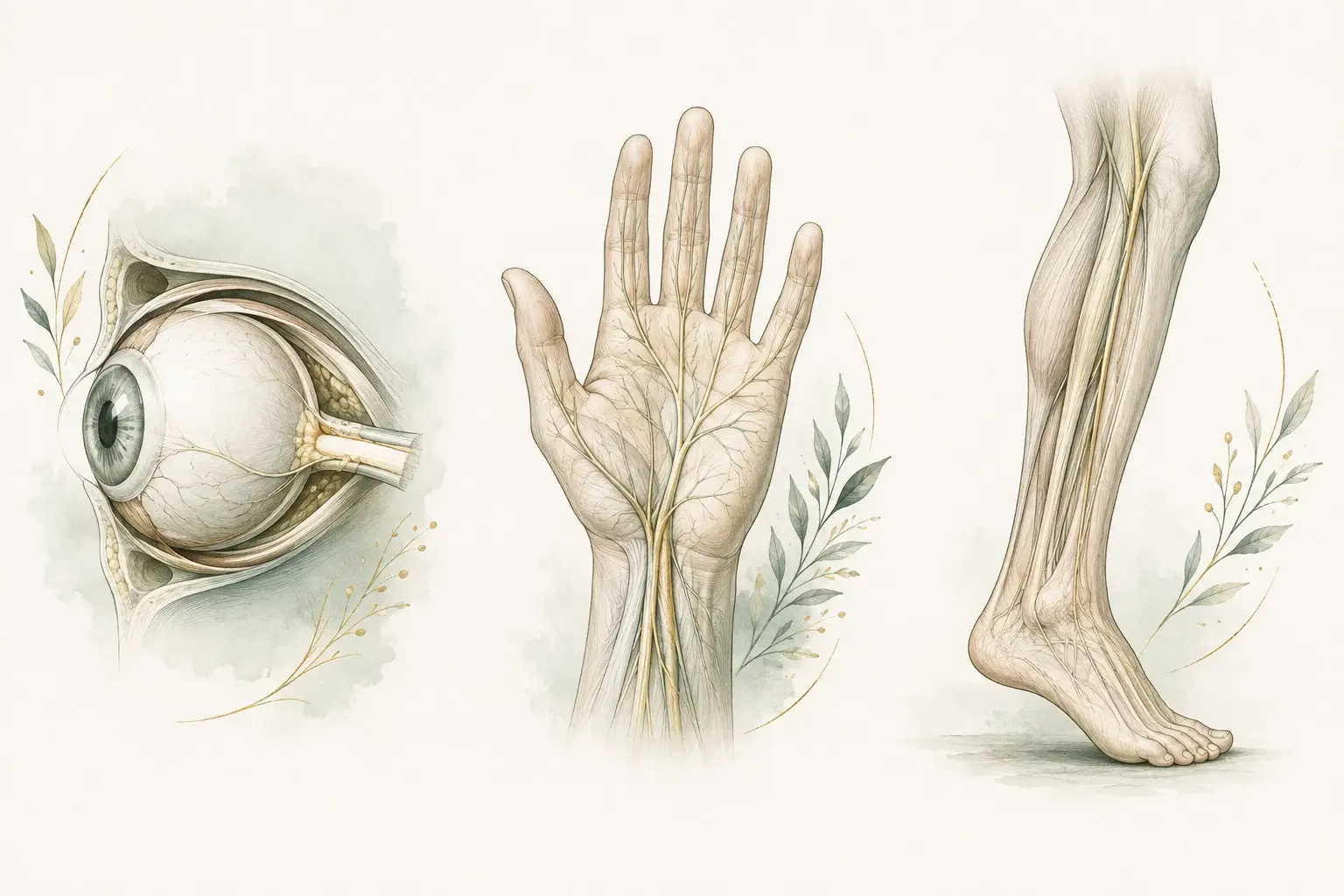
Notice the pattern as well as the symptom
- Vision: Blurred vision with eye-movement pain is one pattern described in this guide.
- Sensation: The location, duration, and course of numbness or tingling matter.
- Movement: New weakness, clumsiness, or unsteadiness belongs in the symptom history.
MS symptoms in women, in men, and after 50
The early signs of MS are the same for everyone. What differs is how often MS starts, when it starts, and how easy the first symptoms are to explain away.
In women
Registries show women are diagnosed with MS two to three times as often as men. The symptoms are the same, but they are easy to put down to stress, hormones, or a new baby. Symptoms can come and go with heat or around a period, which can make them seem less important than they are.
Pregnancy changes the picture for women who already have MS. In the PRIMS study, relapses became roughly 70 percent less frequent in the third trimester and more frequent in the three months after delivery, when about 28 in 100 women had one. Our guide to MS and pregnancy explains how to plan around both. Later in life, menopause brings fatigue, poor sleep, brain fog, and bladder changes that overlap with MS, which can make new symptoms in midlife harder to read.
In men
Men are diagnosed less often and a little later. Their first symptom is more often a slow change, such as walking that gradually gets worse or stiff legs, than a clear attack. That pattern can point to progressive MS. Because the change is gradual, it is easy to blame on age or an old injury.
After 50
MS can start after 50, though less often, and usually as a walking problem that worsens slowly rather than a sudden attack. White spots on MRI become common with age, high blood pressure, and other vascular risks, so the diagnosis takes more care at this age. The 2024 McDonald criteria ask for extra evidence in people over 50, such as a typical spinal cord lesion or a positive spinal fluid test, before MS is diagnosed.
Symptoms that can appear years before diagnosis
One of the more interesting findings of recent research is that MS may have a prodromal phase, a period in which vague, nonspecific symptoms show up years before the disease is formally diagnosed.
Studies of health records suggest this phase may begin several years, and possibly a decade or more, before diagnosis. During this time, people may experience:
- Increased fatigue without a clear explanation
- Mood changes, including depression and anxiety
- Vague musculoskeletal pain
- More frequent headaches
- Subtle sleep disturbances
- More doctor visits for nonspecific complaints
These findings do not mean that everyone with fatigue or mood changes is heading toward MS. The overwhelming majority are not. What the research helps explain is why so many people, once diagnosed, look back and say, "That is what that was," remembering a stretch of fatigue or a brief visual disturbance that seemed insignificant at the time.
What symptoms are not typically MS
It helps to know which symptom patterns make MS less likely:
- Symptoms that are perfectly symmetrical. MS tends to affect one side more than the other. When both hands or both feet are affected equally and at the same time, other causes such as neuropathy or anxiety are more common.
- Symptoms that never change. MS symptoms characteristically come and go. A symptom that has been constant and unchanging for months or years is less typical of MS.
- Symptoms that last only seconds. Brief electric-like jolts, twitches, or sensations that last a few seconds and do not come back are common in healthy people. MS relapses typically cause symptoms that last days to weeks.
- Isolated muscle twitching. Twitches without weakness are extremely common, especially with caffeine, stress, or poor sleep. They are rarely related to MS.
How an MS symptom behaves, compared with everyday causes
| An MS symptom | Everyday causes | |
|---|---|---|
| How it starts | Builds over hours to days | Comes with an obvious trigger, such as a stressful week, caffeine, or poor sleep |
| How long it lasts | Days to weeks, then improves | A few seconds or minutes, or constant and unchanging for months |
| Where it is | One side more than the other, or a patch on the face, trunk, or one limb | Both hands or both feet equally, at the same time |
| What brings it back | It tends to come and go, and heat, even a hot shower, can bring it back | The same trigger each time, such as caffeine or a poor night's sleep |
| Other clues | Comes with other neurological symptoms, such as vision changes, spreading numbness, or weakness | Twitching without weakness, or fatigue on its own |
One thing I often hear is tingling in both feet at the end of a long day, or an eyelid twitch that has gone on for a week. Both are symmetrical or brief, and in my experience they rarely turn out to be MS.
If your symptoms do not fit the patterns above, that is genuinely reassuring. It is not a verdict, though. Symptoms that persist or keep returning deserve an evaluation whatever pattern they take.
MS vs other conditions with similar symptoms
Anxiety, vitamin B12 deficiency, migraine, fibromyalgia, small vessel changes on MRI, and several autoimmune and infectious conditions can all produce symptoms that overlap with MS, and misdiagnosis in both directions is a real problem. We cover each of these mimics, how neurologists tell them apart, and when a second opinion makes sense in MS or something else?. For the specific question of nerve damage in the limbs versus MS, see peripheral neuropathy vs multiple sclerosis.
How MS is diagnosed
There is no single test that confirms or rules out MS. Neurologists piece together information from several sources, and the process is as much about ruling other things out as it is about ruling MS in.
Neurological examination. Often the most informative first step. Your neurologist checks reflexes, strength, sensation, coordination, vision, and eye movements. MS tends to produce specific patterns on examination, such as brisk reflexes or subtle eye movement abnormalities, that help distinguish it from other conditions.
MRI of the brain and spinal cord. The most important tool in the workup. MRI can reveal white matter lesions, areas of inflammation or scarring, in locations that are characteristic of MS. The pattern and location of lesions tell a neurologist a great deal. For help reading your report, see understanding your MS brain MRI.
The McDonald criteria. MS diagnosis follows a framework called the McDonald criteria, most recently updated in 2024. In simple terms, the criteria look for evidence that the nervous system has been affected in more than one place and at more than one point in time. If you read about the criteria before 2024, our table of the 2017 vs 2024 McDonald criteria shows what changed.
Lumbar puncture (spinal tap). A small sample of cerebrospinal fluid is analyzed for immune markers. It is not always required, but it is very helpful when MRI findings are borderline or when additional confirmation is needed.
Blood tests. No blood test can diagnose MS, but blood work is important for ruling out conditions that look similar, including NMOSD and MOGAD, lupus, B12 deficiency, Lyme disease, and thyroid disorders.

How an MS evaluation fits together
- Examination: Strength, reflexes, sensation, coordination, and vision contribute clues.
- MRI: Brain and spinal cord images help identify characteristic patterns.
- Additional testing: Blood tests and sometimes spinal fluid help clarify the diagnosis.
When to see a neurologist
If you are reading this because something does not feel right, here is a practical way to think about next steps. One exception first: weakness, numbness, or vision loss that comes on within minutes can be a stroke, so call 911.
Many symptoms have simpler explanations. Numbness that lasts a few minutes and goes away, occasional tingling in the hands, or fatigue during a stressful week are extremely common and usually have nothing to do with MS. Brief, symmetrical symptoms with an obvious trigger are less likely to be MS, though only an evaluation can say for certain.
When it is worth being seen. Symptoms that persist for more than a day or two, affect one side of the body more than the other, or follow the patterns described in this article, especially vision changes, spreading numbness, or unexplained weakness, are a reasonable reason to arrange a neurological evaluation. A neurologist who works with MS and demyelinating diseases can distinguish MS from the many conditions that mimic it. If MS is your main concern, you can ask for a focused MS evaluation with an MS specialist in Los Angeles, in person or by video.
How to prepare. Note when your symptoms started, whether they come and go, any earlier episodes you dismissed at the time, and any family history of autoimmune conditions. If you have had an MRI before, bring the images, not just the report.
When a patient comes in with a symptom that has lasted a week and sits on one side, I am already thinking about the examination and the MRI. The pattern, more than the symptom, tells me how quickly to move.
Why finding out early matters. If it does turn out to be MS, learning that early is one of the better things that can happen. Long-term registry data show that people who start disease-modifying treatment within the first year or so after onset are less likely to reach disability milestones than those who start later. There are now many FDA-approved therapies, including highly effective B-cell treatments, and our MS treatment guide explains how they are chosen. If the diagnosis has already been made, our guide for people just diagnosed with MS covers the first weeks.
Not knowing if a symptom could be MS is unsettling. Whether you want a first evaluation or a second opinion, a 60-minute first visit with Dr. Achillefs Ntranos leaves you knowing what the pattern suggests and what happens next. Follow-ups are usually every one to three months and last 30 to 45 minutes. Request a visit in Beverly Hills or Los Angeles, or by video anywhere in California. No referral is needed, and the office confirms within 1 business day.
Frequently asked questions
References
- National Institute of Neurological Disorders and Stroke. Multiple Sclerosis.
- Wallin MT, et al. The prevalence of MS in the United States: a population-based estimate using health claims data. Neurology, 2019.
- American Academy of Ophthalmology. Multiple sclerosis. EyeWiki.
- Makhani N, Tremlett H. The multiple sclerosis prodrome. Nature Reviews Neurology, 2021.
- Kavaliunas A, et al. Importance of early treatment initiation in the clinical course of multiple sclerosis. Multiple Sclerosis Journal, 2017.
- Mayo Clinic. Multiple sclerosis: diagnosis and treatment.
- Sex differences in multiple sclerosis: onset age, clinical course, and progression. 2020.
- Evolving the diagnosis of multiple sclerosis: a new landscape in light of the 2024 McDonald criteria. Biomedicines, 2025.
- Confavreux C, et al. Rate of pregnancy-related relapse in multiple sclerosis (PRIMS). New England Journal of Medicine, 1998.