
"Your MRI is stable." It is the sentence everyone with relapsing-remitting MS hopes to hear, and it usually ends the visit on a good note. And yet the walk from the car takes longer than it did last year. The stairs need a rail. Buttons take two tries. Both things can be true at once. The name for it is progression independent of relapse activity, or PIRA: slow worsening without a relapse, which a routine MRI is not built to catch. It changes what you should ask for at your next appointment.
Two ways MS causes disability
Disability in multiple sclerosis accumulates in two different ways, and they come from different biology.
The familiar way is a relapse: an attack of new inflammation, a step down in function, partial or complete recovery, and sometimes a new level to live at. Relapses come from new lesions, the kind an MRI shows as an enhancing spot. Neurologists call the disability they leave behind relapse-associated worsening.
The less familiar way is a slope: slow, steady worsening with no attack near it, often with no new lesion on the scan, confirmed when it is still there months later. This is progression independent of relapse activity, or PIRA. It comes mostly from ongoing injury to nerve fibers that have already lost their myelin, from smoldering inflammation inside older lesions, and from the nervous system gradually losing its ability to compensate. Some researchers call the same thing silent progression or smoldering MS.
Both patterns can happen in the same person. The steps are easy to notice and easy to date. The slope is neither, which is why it went underappreciated for so long.
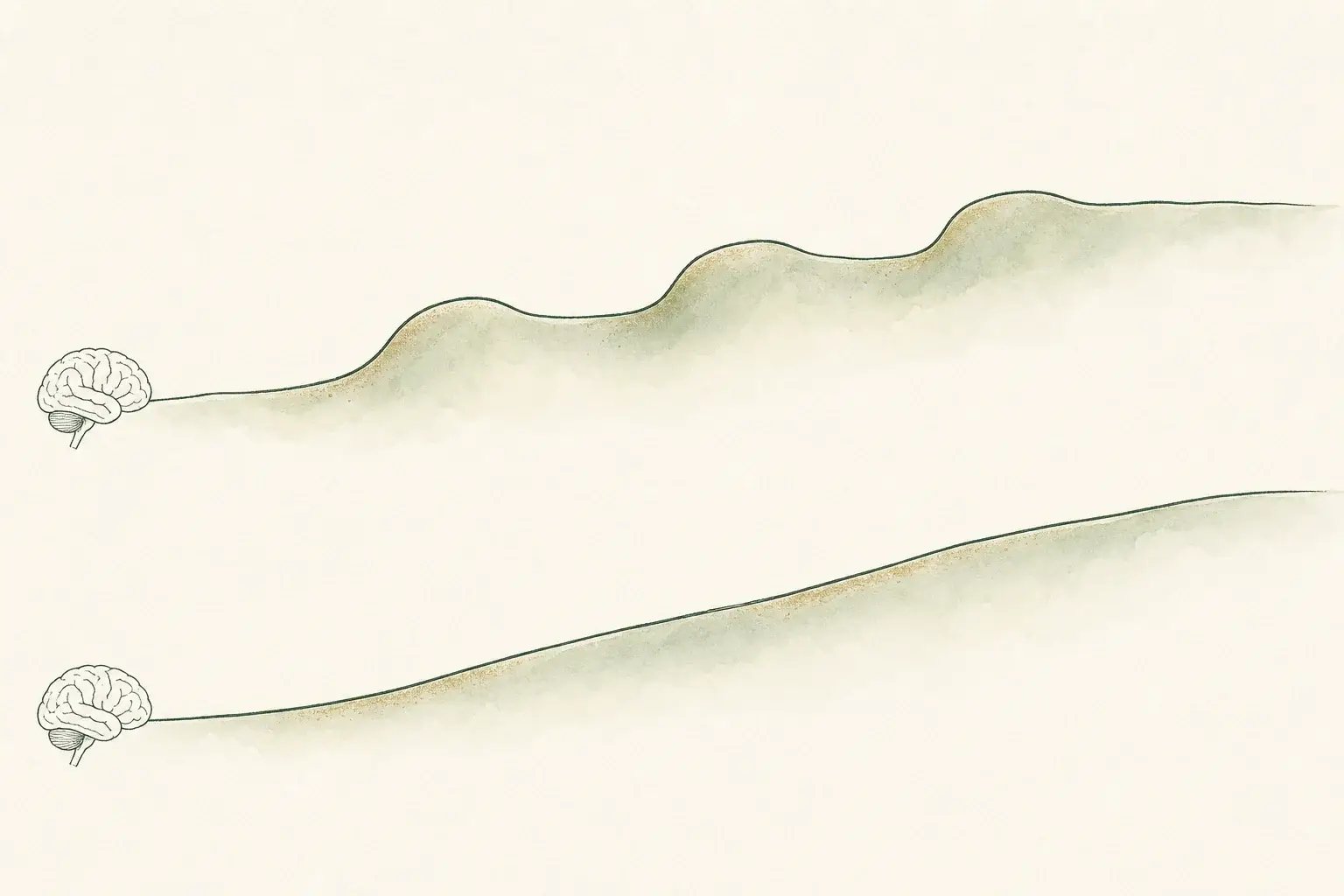
Steps or a slope
- Steps: A relapse, partial recovery, and a new level. Dated by the attack and often visible on MRI.
- Slope: Gradual worsening with no relapse near it, confirmed months later. Often nothing new on the scan.
- Schematic: The two patterns are drawn separately to show the difference, not to scale.
What PIRA feels like: the changes people notice
PIRA rarely announces itself. People usually notice it by comparing this year with last year, and the changes are easy to blame on age, a bad week or the weather. These come up most often:
- Shorter walking distance. The walk from the car or around the block takes longer, or you need a rest you did not need before.
- Stairs. Climbing needs the rail, or one leg tires or drags before the other.
- Buttons and handwriting. Small hand tasks, such as buttons, zips, writing or typing, take more tries or more concentration.
- Stamina. The same day's activities leave you more drained, and recovery takes longer.
- Slower thinking. Following a conversation, multitasking or finding words takes more effort, often alongside the physical changes.
Any of these can have other causes, from heat and infection to sleep, mood or a medication. That is why a change counts as PIRA only when it is measured and still present months later.
How much is which: what the trials showed
The surprise came when researchers went back through large clinical trials and sorted every episode of confirmed worsening by whether a relapse had happened near it.
| Study | Who | What was found |
|---|---|---|
| Pooled OPERA I and II trials (Kappos et al., 2020) | 1,656 people with relapsing MS, followed for 96 weeks | PIRA accounted for 78% of confirmed disability accumulation in the interferon arm and 88% in the ocrelizumab arm. Relapse-associated worsening explained about 18%. The authors' conclusion: "Most disability accumulation in RMS is not associated with overt relapses." |
| Novartis-Oxford MS data pool (Lublin et al., 2022) | More than 27,000 people across all types of MS, about 200,000 disability assessments | PIRA started early, occurred in every type of MS including relapsing-remitting, and became the main driver of disability in the progressive phase. In adult relapsing-remitting MS, PIRA events were more frequent than relapse-related ones |
Two things follow from those numbers. First, PIRA is not a feature of progressive MS alone. It is happening, quietly, inside relapsing MS, and from early on. Second, a follow-up plan built entirely around relapses and new lesions is monitoring the smaller of the two processes.
Why a stable MRI can miss it
A routine monitoring MRI answers a specific question: has new inflammation appeared since the last scan? It does that by counting new or enlarging T2 lesions and looking for enhancement. Our guide to understanding your MS brain MRI explains what each of those findings means. What the scan does not do is measure how well the nerve fibers inside old lesions, and the brain's connections generally, are holding up.
PIRA, meanwhile, was defined in the trials as a confirmed worsening on measures of function: the EDSS disability scale, a timed 25-foot walk, or a nine-hole peg test, with no relapse within the confirmation window and with the baseline reset after any relapse. None of those three instruments is a lesion count.
| What a routine MRI reports | What the slope reflects |
|---|---|
| New or enlarging lesions | Ongoing injury inside lesions that already exist |
| Enhancing lesions (active inflammation now) | Slow loss of nerve fibers and their connections, without a new spot |
| Overall lesion load | Loss of the reserve the nervous system uses to compensate |
| "Stable" when none of the above changed | Worsening that only shows on a measure of function |
That is why "stable" and "worse than last year" can both be accurate. They are answers to different questions.
How progression is actually measured
Progression is measured, not guessed, and the measures are simple. Each takes minutes, and each turns "I think I am slower" into a number that can be compared a year later.
- Timed 25-foot walk. How long it takes to walk 25 feet as quickly and safely as you can. A meaningful change is a 20% slowing, confirmed on a later visit.
- Nine-hole peg test. How long it takes to place nine pegs in nine holes and remove them, one hand at a time. It tracks the fine hand function that buttons, typing, and cooking depend on.
- EDSS. The Expanded Disability Status Scale, the standard score a neurologist assigns from the examination, weighted toward walking.
- Cognitive screening. A short timed test of processing speed, because thinking speed can slip along the same slope as walking.
- Blood and imaging markers of ongoing injury. A neurofilament light chain blood test read as an age-adjusted z-score, and brain volume measurements across scans, add information about how much damage is ongoing. They support the functional measures; they do not replace them.
A change on any of these is treated as real only when it is still present three to six months later. That confirmation step is what separates progression from a bad week, a hot day, or an infection.

Turning an impression into a number
- Timed walk: Twenty-five feet, timed, at each visit.
- Peg test: Nine pegs in and out, one hand at a time.
- Confirmed later: A change counts when it is still there months afterwards.
What it changes
Ask for your function to be measured, not only your scan read. If your visits record lesion status but not a timed walk or a peg test, PIRA cannot be detected by design. Asking for those measures is a reasonable request, and it costs a few minutes.
Confirmed progression on a stable MRI is a legitimate reason to revisit treatment. A confirmed slope is worth a conversation about whether the current disease-modifying therapy is the right one, and about what else could protect function. The conversation is individual, and the decision belongs to you and your neurologist.
Can PIRA be treated or slowed?
Partly. Nothing yet stops PIRA, but several things slow it or protect the function it takes away.
- An effective disease-modifying therapy. In the pooled OPERA analysis, the higher-efficacy therapy, ocrelizumab, cut relapse-associated worsening roughly in half but cut PIRA by only about a fifth. Suppressing new inflammation addresses the steps more than the slope, but it still helps.
- Rehabilitation and exercise. Physical therapy, strength and balance work, and treatment of spasticity aim at the very things the slope takes away: walking, stamina and hand use. They are not a consolation prize. In progressive disease they are among the interventions with the best evidence for keeping people mobile, and the same logic applies when the slope appears inside relapsing MS.
- Vascular risk. High blood pressure, diabetes, high cholesterol and smoking are each linked to faster disability in MS. Treating them, and stopping smoking, protects the reserve the nervous system uses to compensate.
- Treatments aimed at smoldering inflammation. The slow inflammation inside older lesions is the focus of much current research and of clinical trials. The closest to the clinic are BTK inhibitors, oral medicines that act on immune cells inside the nervous system: in September 2026 the FDA accepted an application for one of them, fenebrutinib, for priority review in relapsing and primary progressive MS. None is approved yet.
Two different questions
At your next visit, notice that these are two different questions:
- "Any new lesions?" answers whether new inflammation has appeared. It has a scan.
- "Am I worse than a year ago?" answers whether function is holding. It needs its own measurement.
A good MS follow-up asks both. If only the first is being asked, the second is worth raising yourself.
When to see an MS specialist
See an MS specialist if walking, stamina, balance, or hand function has slowly worsened over months while your scans have been reported as stable, if you have noticed it and been told it is nothing because the MRI is unchanged, or if you want your function measured so that next year's visit has something to compare against. Your MRI can be stable while the stairs get harder, and that slope can be measured. At our Multiple Sclerosis Clinic, Dr. Ntranos, a fellowship-trained MS specialist, reviews your MRI with you, measures function at each visit so "I think I am slower" becomes a number, and works through the treatment options, including trials. The first visit is 60 minutes, in person in Beverly Hills or Los Angeles, or by video anywhere in California; the timed walk and peg test are done at in-person visits. Follow-ups are usually every one to three months and last 30 to 45 minutes. Appointments are usually available the same or next day. Request a visit with no referral and upload your records ahead through our patient tools page; the office confirms within 1 business day.
Frequently asked questions
References
- Kappos L, Wolinsky JS, Giovannoni G, et al. Contribution of relapse-independent progression vs relapse-associated worsening to overall confirmed disability accumulation in typical relapsing multiple sclerosis in a pooled analysis of 2 randomized clinical trials. JAMA Neurology, 2020;77:1132-1140.
- Lublin FD, Häring DA, Ganjgahi H, et al. How patients with multiple sclerosis acquire disability. Brain, 2022;145:3147-3161.
- Cree BAC, Hollenbach JA, Bove R, et al. Silent progression in disease activity-free relapsing multiple sclerosis. Annals of Neurology, 2019;85:653-666.
- Benkert P, Meier S, Schaedelin S, et al. Serum neurofilament light chain for individual prognostication of disease activity in people with multiple sclerosis: a retrospective modelling and validation study. The Lancet Neurology, 2022;21:246-257.
- National Institute of Neurological Disorders and Stroke. Multiple sclerosis.